
How to Choose Sound Insulation Panels for Any Space?
Noise is not merely an annoyance. It affects concentration, sleep, privacy, and workplace performance. The World Health Organization estimates that environmental noise causes more than one million healthy life-years lost annually in Western Europe. The European Environment Agency also reported that over 113 million people faced harmful road-traffic noise exposure in Europe. These findings make acoustic planning a practical building requirement, not a decorative upgrade.
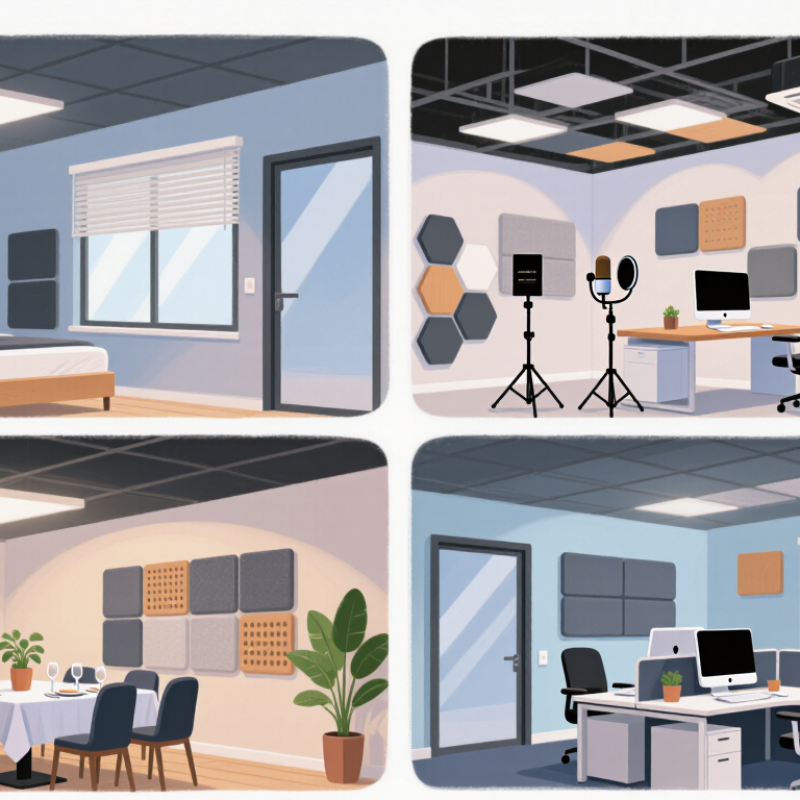
Choosing sound insulation panels requires more than comparing thickness or price. Start with the noise source, transmission path, and room function. A bedroom beside a busy street needs a different solution from a podcast studio or restaurant ceiling. Wall mass, airtight joints, doors, windows, and structural connections can matter as much as the panel itself. No panel solves every room. That assumption deserves reconsideration.
Laboratory ratings provide useful guidance. ISO 10140 describes methods for measuring airborne sound insulation in building elements, while ISO 717-1 explains single-number ratings such as Rw. ASTM C423 commonly evaluates sound absorption, often represented by the Noise Reduction Coefficient. These measurements are not interchangeable. A panel may absorb reflections inside a room without significantly blocking sound through a wall. Consider frequency performance, fire classification, moisture resistance, installation depth, and maintenance needs. Manufacturer claims should be checked against test reports from accredited laboratories. In real projects, careful installation often decides whether promising specifications become noticeable results. Even experienced designers can overlook flanking noise, which travels around the selected barrier. This guide examines how to match sound insulation panels with different spaces, acoustic problems, and performance expectations.
Understanding How Sound Insulation Panels Work
How to Choose Sound Insulation Panels for Any Space?
Understanding How Sound Insulation Panels Work
Sound insulation panels do not simply “stop” noise. Most porous panels absorb sound energy inside a room. Fibers and open cells slow air movement, reducing reflections from walls and ceilings. This can soften speech, machinery noise, and the sharp echo in a bare office. However, absorption is not the same as blocking. A thin wall panel cannot prevent every sound from passing through a shared wall.
Check the test data before choosing a panel. ASTM C423 measures sound absorption in a reverberation room, while the Noise Reduction Coefficient averages absorption at selected frequencies. A higher NRC can improve room comfort, but it does not prove strong airborne sound insulation. For wall-to-wall transmission, look for tested assemblies under standards such as ISO 10140 and ISO 717-1. Installation matters too. Gaps around edges can weaken real performance.
The World Health Organization recommends keeping nighttime outdoor noise below 40 dB Lnight to protect sleep, with 55 dB treated as an interim target in difficult situations (WHO Environmental Noise Guidelines, 2018). That target is useful, but panels alone may not achieve it. Start with the noise source, then inspect doors, glazing, ducts, and wall joints. In practice, I would rather see modest panels installed continuously than expensive panels surrounded by gaps. This is where many specifications become too optimistic. A room can look quieter and still measure poorly.
| Panel Type | How It Works | Typical Materials | Common Thickness | Typical Acoustic Performance | Best Applications | Key Selection Considerations |
|---|---|---|---|---|---|---|
| Porous Absorber Panels | Convert part of the sound-wave energy into a small amount of heat as air moves through the panel’s fibrous or open-cell structure. | Mineral wool, fiberglass, polyester fiber, or acoustic foam. | 25–100 mm | Typical NRC: 0.40–0.95, depending on thickness, density, facing, and mounting air gap. | Offices, classrooms, studios, meeting rooms, restaurants, and home theaters. | Thicker panels and an air gap generally improve low-frequency absorption. They reduce reverberation but do not independently block sound passing through a wall. |
| PET Fiber Panels | Absorb reflected sound through a lightweight, porous fiber structure while providing a durable decorative surface. | Recycled or virgin polyester fiber. | 9–24 mm | Typical NRC: 0.35–0.90, depending on panel thickness and installation method. | Open-plan offices, ceilings, wall features, schools, corridors, and retail interiors. | Useful where low weight, shape flexibility, and visual customization are important. Verify the product’s fire classification for the intended building type. |
| Fabric-Wrapped Acoustic Panels | Use a sound-transparent fabric over a porous core to absorb mid- and high-frequency reflections. | Fabric face with fiberglass, mineral wool, or polyester core. | 25–100 mm | Typical NRC: 0.60–1.00 for well-designed thicker panels with suitable mounting. | Conference rooms, recording rooms, auditoriums, libraries, and executive offices. | Check fabric durability, cleanability, edge construction, and whether the covering is acoustically transparent rather than decorative and reflective. |
| Wood Slat or Perforated Panels | Combine a reflective wood surface with an absorptive backing; perforations or slots allow sound energy to reach the absorber. | Wood veneer, MDF, plywood, perforated wood, and mineral wool or PET backing. | 20–60 mm | Typical NRC: 0.30–0.85, depending strongly on open area, backing, cavity depth, and panel design. | Restaurants, hospitality spaces, offices, auditoriums, and architecturally finished interiors. | Choose the open-area ratio and backing system carefully. Solid, unperforated wood primarily reflects sound rather than absorbing it. |
| Acoustic Foam Panels | Use open-cell foam to dissipate reflected sound energy, particularly in the mid- and high-frequency range. | Open-cell polyurethane or melamine foam. | 25–100 mm | Typical NRC: 0.30–0.90, depending on profile, thickness, and test method. | Voice rooms, broadcast spaces, workshops, and small recording environments. | Foam performance is frequency-dependent. Confirm fire behavior, UV resistance, aging characteristics, and cleaning requirements before public-space use. |
| Composite Barrier Panels | Use added mass, damping, and sometimes decoupling to reduce sound transmission through partitions or equipment enclosures. | Mass-loaded vinyl, gypsum-based boards, cement boards, elastomeric layers, or multilayer composites. | 3–25 mm per barrier layer | Transmission loss is installation-dependent; there is no universal panel-only value for a finished wall. | Plant rooms, machinery enclosures, partition upgrades, doors, ceilings, and areas requiring transmission control. | Sealed joints, perimeter detailing, flanking paths, structural connections, and total wall construction often matter more than the panel alone. |
| Bass Traps and Low-Frequency Panels | Use greater depth, porous absorption, or tuned resonant construction to control long-wavelength low-frequency sound. | Thick mineral wool, fiberglass, membrane absorbers, or perforated resonant systems. | 100–300 mm or more | Designed for lower-frequency control; results depend on depth, placement, and room modes. | Recording studios, home theaters, music rooms, and rooms with noticeable bass buildup. | Thin decorative panels are usually insufficient for strong low-frequency problems. Measure the room or obtain acoustic advice before selecting a tuned system. |
| Ceiling Baffles and Clouds | Absorb sound from both sides while interrupting reflections between the ceiling and occupied area. | Suspended PET, fiberglass, mineral wool, or fabric-wrapped panels. | 25–100 mm | High effective absorption area because both faces and edges can contribute when suspended. | Open offices, classrooms, cafeterias, warehouses, and large rooms with hard ceilings. | Consider suspension height, sprinkler and lighting coordination, cleaning access, wind movement, and the amount of exposed surface area. |
| Outdoor or Moisture-Resistant Panels | Provide sound absorption using materials and finishes selected to tolerate humidity, occasional moisture, or changing temperatures. | Closed-cell or treated acoustic materials, perforated weather-resistant systems, and coated fiber products. | 20–100 mm | Performance varies by weatherproof construction; laboratory indoor ratings may not represent outdoor conditions. | Covered terraces, transport areas, swimming-pool zones, plant rooms, and semi-exterior spaces. | Check water absorption, drainage, corrosion resistance, UV stability, wind loading, and the manufacturer’s environmental test data. |
| Selection note: Sound absorption panels primarily improve room acoustics by reducing reflections and reverberation. Sound insulation or sound blocking requires a complete tested construction with sufficient mass, airtightness, damping, decoupling, and controlled flanking paths. NRC values are indicative ranges only; always review project-specific laboratory data, fire ratings, moisture resistance, and installation details. | ||||||
Related Posts
-
Top Sound Panels for Better Room Acoustics?
-
What Are the Best Types of Soundproof Panels?
-

China Top Sound Treatment Panels Manufacturers?
-
What Are Sound Insulation Panels and How Do They Work?
-

How to Choose Acoustic Treatment for Your Space?
-

Discover the Best Acoustic Panels in China for Your Needs?