How to Choose the Best Acoustic Panels?

Choosing the best acoustic panels begins with listening to the room, not browsing colors. Does speech blur across a meeting table? Does music linger after the final note? These details reveal whether reflection, echo, or excessive reverberation is the real problem. Acoustician Wallace Clement Sabine’s work established reverberation time as a way to measure how quickly sound decays. A practical summary of his principle is: “Reverberation time measures how long sound takes to decay by 60 decibels.” It is a useful starting point, not a complete buying rule.

The right acoustic panels depend on room size, surfaces, sound sources, and intended use. A home office with bare glass and a hard desk needs a different treatment from a dining room or recording space. Check panel thickness, core material, tested absorption data, mounting method, and coverage area. A soft fabric face alone does not prove strong acoustic performance. Nor will panels block every sound from a neighbor; absorption mainly helps manage sound inside a room. Small distinctions matter.

This guide will compare panel materials, performance ratings, placement, safety, and budget. It will also explain how to match specifications to everyday listening conditions. A simple test helps: clap once, then notice the tail. Still, room acoustics are rarely solved by one neat formula. I would be cautious about promising a perfect result from a product page alone. The best choice is the one supported by clear measurements and a realistic plan for the room.
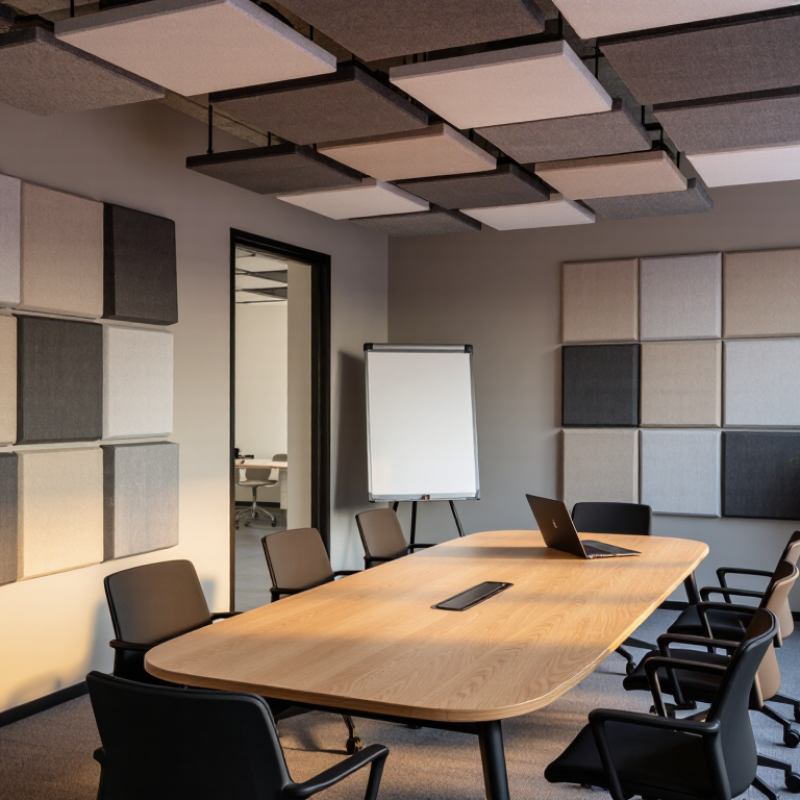
How to Choose the Best Acoustic Panels?

Define the Room’s Noise Problem and Identify the Frequencies to Control

How to Choose the Best Acoustic Panels?

Define the Room’s Noise Problem and Identify the Frequencies to Control

Before choosing panels, identify what sounds wrong in the room. A sharp clap that rings suggests excessive reverberation. Muffled speech may point to reflections between hard walls. Low notes that linger near a corner suggest a bass buildup. That distinction matters. Standard panels often absorb mid and high frequencies more effectively than deep bass, so adding thin panels may leave a boomy sound unchanged.

Listen from several places, not just your usual seat. Speak aloud, play familiar music, and notice whether consonants blur or bass notes seem uneven. A phone recording can help reveal patterns, though its microphone is not a calibrated measuring tool. For more precision, use a room-measurement microphone and software to inspect the frequency response. Room dimensions and furniture also affect what you hear. It is easy to blame the walls alone; sometimes the listening position is part of the problem.

Compare NRC Ratings: ASTM C423 Averages Absorption at 250–2,000 Hz

When comparing acoustic panels, look beyond the NRC figure. Under ASTM C423, the Noise Reduction Coefficient averages absorption measurements at 250, 500, 1,000, and 2,000 Hz, then rounds the result to the nearest 0.05.

That matters.

A panel with an NRC of 0.80 does not absorb 80 percent of every sound in every room. It reports an average across four specific test frequencies.

Check the full frequency table when available. A meeting room with sharp speech echoes may benefit from strong mid-frequency absorption, while a room with a steady bass hum needs data below 250 Hz.

Not the whole story.

Compare test reports using the same mounting conditions, since panel thickness, an air gap, and installation details can affect results. Picture a panel mounted directly on drywall beside one installed with space behind it: their ratings may not reflect the same setup.

I would not choose by NRC alone; I have found the number useful for screening, but incomplete for predicting a finished room’s sound. Ask for the ASTM C423 report and match its test configuration to your planned installation.

Select Panel Thickness and Air Gap for Better Low-Frequency Absorption

How to Choose the Best Acoustic Panels?

Select Panel Thickness and Air Gap for Better Low-Frequency Absorption

For bass control, panel thickness and wall spacing matter more than a tidy-looking surface. A 100 mm porous panel with a 100 mm air gap can absorb lower frequencies more effectively than the same panel mounted flush, though exact results depend on material and installation. The physics sets a useful limit: sound travels about 343 metres per second, so a 125 Hz wave is roughly 2.7 metres long. A thin panel cannot absorb that whole wave. It can still reduce room reflections. There is no magic thickness.

Check frequency-by-frequency test data, not just a single headline rating. ASTM C423 measures sound absorption in a reverberation room, while ISO 354 specifies a related laboratory method. Ask for results that identify panel thickness and mounting air gap; changing either can change the curve. The Noise Reduction Coefficient is a helpful summary, but it averages selected mid-frequency bands and can hide weak bass performance. For a room with a persistent 125 Hz hum, inspect the 125 Hz result and compare practical setups. Leave a visible cavity behind the panel where possible. Measure, listen, and adjust; room modes can make one corner behave very differently from another.

How to Choose the Best Acoustic Panels? - Select Panel Thickness and Air Gap for Better Low-Frequency Absorption

Panel Thickness Air Gap Total Depth from Wall Quarter-Wavelength Reference Typical Use and Low-Frequency Guidance
25 mm (1 in) 0 mm 25 mm About 3,430 Hz Very shallow treatment, mainly useful for higher frequencies. Limited low-frequency absorption.
50 mm (2 in) 50 mm (2 in) 100 mm About 860 Hz A practical space-saving option for reducing mid-to-high-frequency reflections. The air gap improves performance compared with mounting the panel directly on the wall.
75 mm (3 in) 75 mm (3 in) 150 mm About 570 Hz A balanced choice for rooms with moderate mounting depth. More useful in the lower midrange than a thin, wall-mounted panel.
100 mm (4 in) 100 mm (4 in) 200 mm About 430 Hz A strong general-purpose option when controlling lower-midrange reflections is important. Suitable for studios, listening rooms, and home theaters with adequate wall clearance.
150 mm (6 in) 150 mm (6 in) 300 mm About 290 Hz A deeper porous absorber can provide more useful absorption at lower frequencies, subject to the absorber material and installation details.
200 mm (8 in) 200 mm (8 in) 400 mm About 215 Hz A space-intensive configuration for rooms needing broader low-frequency control. Deep bass may still require substantially thicker treatment or purpose-designed bass traps.
Approx. 343 mm (13.5 in) Approx. 343 mm (13.5 in) Approx. 686 mm About 125 Hz Illustrates the substantial depth associated with porous absorption at very low frequencies; this is generally impractical as a standard wall panel.

How to interpret the reference: The quarter-wavelength frequency is calculated from the total panel-plus-gap depth using a sound speed of approximately 343 m/s. It is a depth reference, not a guaranteed absorption cutoff. Actual absorption depends on material thickness, airflow resistivity, mounting, frequency, and test conditions; consult independent test data for a specific panel.

Verify Fire Performance: ASTM E84 Class A Requires a Flame-Spread Index of 0–25

When choosing acoustic panels, treat fire documentation as a core performance check. Under ASTM E84, Class A requires a flame-spread index (FSI) of 0–25; the 2024 International Building Code also sets a smoke-developed index limit of 450 for this class. Check both values on the test report. A low FSI alone does not confirm every fire-related requirement.

ASTM E84 measures surface-burning characteristics in a controlled tunnel test. It does not establish a panel’s fire-resistance rating or predict how a finished room will behave in a fire. Results can depend on the tested product, backing, mounting method, and substrate. Match the report to the exact panel assembly you plan to install. A report for a similar-looking material is not enough. Details matter.

Tips: Ask for the full ASTM E84 report, not just a “Class A” claim. Confirm the listed FSI is 0–25 and check the smoke-developed value. Compare the tested installation with your wall or ceiling details. If those details differ, pause and ask a qualified fire-safety professional to review them. Small mismatch, big uncertainty.

Estimate Panel Coverage in Sabins: 1 Sabin Equals 1 ft² of Open Window

Acoustic panels are easier to compare when their sound absorption is expressed in sabins. One sabin equals the absorption of one square foot of open window. This is a reference point, not a claim that a panel behaves exactly like a window. The rating tells you how much sound a product can absorb, rather than how much wall it covers.

For a rough estimate, multiply the panel’s absorption per square foot by its face area. A panel rated at 0.8 sabin per square foot and measuring 10 square feet provides about 8 sabins at the stated test conditions. Check the frequency details: absorption can change between bass notes and speech frequencies. A single figure may hide that difference. Useful, but imperfect.

Then consider the room. A small, hard-walled office with a sharp echo may need less added absorption than a large, bare meeting room. Estimate the room’s existing absorption, then compare it with the amount needed to reduce reverberation. Placement matters, too. Panels near reflection points can make voices clearer, while covering every wall may not be necessary. Leave space for doors, windows, and useful reflective surfaces. When specifications are unclear, ask for frequency-based absorption data before choosing by panel thickness or appearance alone.

How to Choose the Best Acoustic Panels?

Estimate Panel Coverage in Sabins: 1 Sabin Equals 1 ft² of Open Window

A Sabin represents the sound absorption of one square foot of an open window. The chart shows this direct unit conversion; it is not a rating of any specific acoustic panel. Panel absorption varies by frequency, so compare tested Sabin ratings or absorption data when estimating the coverage you need.